



Quick Summary
In this twelfth installment of the Rolling Tides series, Tristan LaHaye rides the Trans Ecuador Mountain Bike Route solo, a 1,381 km dirt-road traverse past Cotopaxi, Quilotoa, and Chimborazo through the Quechua farming communities of the high Andes. He mixes vivid road moments (chasing dogs, nights in a fire station and cow pasture) with reflections on invasive eucalyptus and pine, youth leaving for the cities and the US, and the gap between Ecuador’s dangerous reputation and the everyday kindness he finds in the mountains. His time in Ecuador ends as the rainy season arrives and he pushes south through Cuenca and Loja toward the Peruvian border.
Words and Photos by Tristan LaHaye - @baby.ogre.motor @rollingtides.rt
This is the twelfth post documenting the surfpacking / bikepacking / backpacking adventure that began with Rylie and Tristan starting in different parts of the world, rejoining in the US, and making their way to Central America. Now, Tristan continues the journey solo again until the end of the road in South America. Read about the ambitious journey in Part 1 HERE, Part 2 HERE, Part 3 HERE, Part 4 HERE, Part 5 HERE, Part 6 HERE, Part 7 HERE, Part 8 HERE, Part 9 HERE, Part 10 HERE, and Part 11 HERE. Tune in each month to see how it's going.
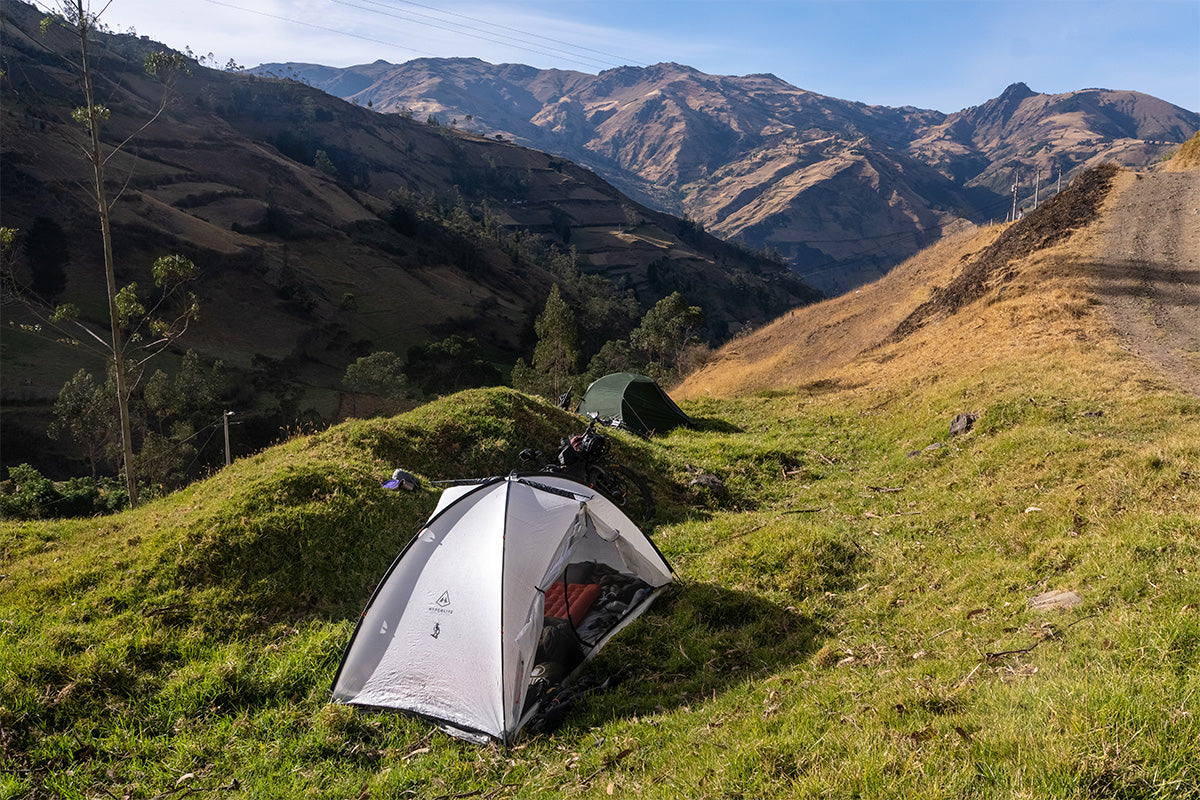
 I stir my pot of Quinoa and veggies as the sun completely disappears, giving way to darkness. This feels right - the stillness. The lack of cars, commotion, and organized chaos of Quito, a beautiful city on all accounts. I feel more at home here, alone but for the trees, eucalyptus, and pine. Neither species is native to Ecuador, and they were imported for farming and harvesting their wood. Terribly, they have been devastating ecosystems in a systematic way. To start, they consume vast amounts of water, drying up precious streams and soil. Their acidic needles and leaves suffocate the understory, change the pH balance of the ground, and suppress the growth of native plants. The trade-off of their economic benefit and wonderful smell seems too high a price to pay for their incredible harm. The smoke from the forest fires they perpetuate often lingers in the September air, as everyone holds their breath for the arrival of the rains.
Tonight I share the front yard with a herd of cattle. The big mooing beasts surprised me, with dozens of expectant eyes reflecting the light of my headlamp. I suppose I surprised them too; this is their yard, after all.
 After slurping down my dinner, I lie in my tent, and my body turns to lead. It's satisfying in a way, feeling completely and utterly spent like this. But it’s also a part of the way I approach life that I struggle to change- separating effort and relaxation drastically. Ride hard, rest hard. Work hard, reward hard. The metaphorical seesaw hits the ground a bit too hard on either side. I reflect on trying to meld these two mentalities together a little more, let them ooze into each other. But before reaching any significant breakthroughs, I’m lulled to sleep by the trickling stream and the mooing of neighbors.
 When planning this journey, Rylie and I wanted to find a way to give back to the land and try and have a positive impact on places we travel through. We felt most drawn towards land protection, and through our American friends at Conserve.org, we were connected with Jocotoco, an Ecuadorian NGO doing incredible work in protecting critical ecosystems. Getting the opportunity to meet their wonderful team and finally see the ecosystems they’re protecting was incredible, and I’ll share the story in the next article. For now, if you’d like to support their work, you can do so through the conservation section on my website, rollingtides.net.
 The Trans Ecuador Mountain Bike Route (TEMBR) is a connection of dirt roads weaving through paramos, mountain towns, and pastures. It runs down the length of the country, spanning 1,381 km with over 35,000 m of climbing. Much more than just a challenging bike ride, the TEMBR is an invitation to experience Ecuadorian culture more intimately, especially the agricultural lifestyle of the high mountains. The strenuous daily uphill riding is but a taste of the challenges of local life. Dirt tracks carve through hillsides, where every bit of farmable land has been laboriously worked into a patchwork quilt of sustenance. Communities of Quechua people, the largest indigenous group in South America, grow mostly potatoes, quinoa, and corn, their colorful woven clothes standing out brightly among the hills as they work. They speak their own language, Quechua, which varies from region to region. I find the sounds of it intriguing and beautiful, but struggle to remember the few words I’m taught. Still, I stop to chat when appropriate, and we communicate in basic Spanish and facial expressions. I often pedal away with a swelling heart from the sweetness of these shy mountain folk and the laughter they leave on the wind.
 Work opportunities outside of agriculture are scarce in Ecuador at the moment, and most are concentrated in the big cities of Quito and Cuenca. In the valley of Angamarca, a man named Angel was drawn to our odd collection of pitched tents and bicycles in the grass one morning. I’d been biking on and off with some British cyclists, and over breakfast Angel spoke to us of life in the valley. All the youth were moving away to the city to find paying jobs, leaving the older population to continue working the fields and herds. A few years ago, a group of neighbors from the valley had left for the promised land of the US. They took trucks and buses and hiked many miles to cross borders headed North. Eventually the group made it, but not before an older man lost his life, taxed by the physical strain of the journey. Angel told us this, solemnly shaking his head at Trump. “Feo,” he says. “I wonder, is the American Dream still alive?”
 Cotopaxi is one of the world’s highest active volcanoes. Its famous conical shape reaches so high into clouds that it’s often obscured from view. I approached its hidden form aboard the back of snaking singletrack, following the imprinted memory of previous pedalers in the volcanic sand. Hoping to see the famous snow-capped peak, I whimsically shouted at the clouds, “OPEN UP! PLEASEEEEE.” They didn’t, but that's okay. I was happy enough to be up there, all alone but for some grazing horses, looking mighty majestic. I had just swapped my front tire for a sweet, plump, plus-sized 2.8-inch one, and it made the rough ride feel smooth as butter. It wasn’t perfectly seated on the rim, though, so I found an air compressor back in town to help pop it into place. Like an absolute goof, I kept feeding it little bits of air, hoping to hear the telltale “POP” of it slipping into place. What I heard instead was a “BANG!” as it exploded in my face. I stared into space, ears ringing, vision blurred. It felt like a scene from a movie.
 Tire sealant covered me from head to toe, dripping down my face and gluing my eyelashes together. I was shocked at what I’d done; it was such a silly mistake. I’d overinflated it until it popped off the rim, something I vowed at that moment to never do again. After cleaning up the poor mechanics shop (which was also full of glue) we assessed the damage. Luckily, the tire wasn’t torn, just badly warped. Too warped to roll, unfortunately. I started cutting off side knobs with a dull blade, hoping it would help clear the sides of my fork and allow me to roll, at least to a bigger town where I could find a tire. That's when a man rolled up on his bicycle and took control of the mess. He torqued on the spokes of the wheel itself, misaligning it to counteract the warp of the tire. It worked, and I was lucky to roll away from that one, even if my front wheel was comically wobbly. It ended up holding the remaining 600 or so kilometres to Cuenca, where the tire manufacturer’s retailers hooked me up with some fresh rubber for the road ahead.

 The TEMBR weaves around two more of Ecuador’s most famous Volcanoes: Quilotoa and Chimborazo. Quilotoa has a stunning crater lake with a mesmerizing color. Chimborazo is the tallest of the three, towering at 6,268m above sea level. Interestingly, its peak is actually farther from the center of the Earth than Everest, making it the highest point on Earth. Due to the constant centrifugal force on the planet, the Earth isn’t perfectly round, bulging out at the equator. So, Chimborazo reaches to the heavens, higher than the Himalayas. Who knew? Not me, that's for sure.
 Together with Ben and Dan, the British riders, we steadily climbed our way past its cloud-covered base, making it up as high as 4,400 m, the highest we’d been on the trip so far. It was a cold, barren landscape where the air was thin. Not wanting to spend a sleepless night at altitude, we ate some more cookies and pushed on, relishing the heroic descent to the next bustling market town. There, a glorious 5$ hotel awaited us, with icy cold showers and toilet seats covered in the offerings of the previous guests.

 The dogs are meaner here in the mountains. Something about bicycles gets them riled up, set on chasing and gnashing at heels. Could it be that I resemble a clumsy cow escaping down the street? Or maybe they’re insulted by my lack of cleanliness, as the stench from my unwashed clothes hits their too-sensitive noses (Ben renamed my bike from Surly Ogre to Surly Odor). Whatever it may be, the fact remains that they are scary and quite dangerous. I’ve heard numerous tales of cyclists being mauled and needing to cut their trip short to receive medical care and ongoing rabies treatment - this scares me more than the mauling itself. So here are some tried-and-tested techniques I’ve been using to deal with the ones that menacingly give chase:
-Bark back loudly, pretending to be an even tougher dog
-Lift up feet out of easy reach
-Kick them in the face
-Stop and have a friendly chat
-Squirt them with water
-Throw a rock I’ve been carrying for this specific purpose. If there is no rock, pretend to throw one.
-Spit in their face (particularly effective)
As it goes, their barks still echo into the night, bouncing off the walls of the fire station where I try to sleep, tent nestled between fire trucks. I wake early in the morning to the fire bell, announcing the start of another day. The kind firefighter who welcomed me into their space mops the floor around me and my bicycle, asking a question I receive almost daily. “Aren’t you scared?” Ecuador is currently ranked as one of the most dangerous countries in the world, and the most dangerous in South America. Mostly, this statistic comes from conflict in the lowlands, closer to the coast. Up where we are in the mountains, it is considerably safer.
 The firefighter tells me to be careful on the way out; there are robbers in this town, and apparently, they kill their victims too. A harsh reality check for a boy on a bike, although I still never felt unsafe. Maybe it's luck, or the privilege of men mixed with a dash of ignorance, but it still seems to me like people doing good vastly outnumber those causing harm in the world. My days are spent witnessing acts of kindness, yet the screens in the restaurants here show nothing but violence and crime in faraway cities. Other bike travelers I met on the road said, “It feels like we’re in a completely different country than the dangerous Ecuador everyone is talking about.” They weren’t wrong. Willy, a burger stand owner, used to live on the streets of Guayaquil. “Here it's peaceful,” he said. “But where I’m from, you wouldn’t make it very far on that bike; you would get robbed on the first bridge you try and cross.” Heard, loud and clear.

 The mountains are peaceful still, and the rhythm of life continues in the form of a food tour. I eat to live and live to eat. My body is like a furnace, greedily burning any form of energy I put into it. That is, when it’s not upset from mild cases of food poisoning. Food is abundant though, and always accessible. Soups, grilled chicken, roadside fries, rice, mote, encebollados, bakeries, fresh fruit and veggies. For a hungry bikepacker, it’s paradise. I carbo-load with so many little breads smeared with jam, or just jam (I squeeze the little tubes into my mouth, imagining it’s a fancy carb gel).
 The rains arrive in late September as I push further South, passing through the colonial cities of Cuenca and Loja. The dry season has come to a close, and it is a relief for the growing fires and thirsty crops. For me, it just means cold and soggy mountain passes. Afternoon showers have become the norm, and I don all my rain gear to stay warm- waterproof pants, jacket, waterproof mitten liners, and waterproof socks to keep my feet comfy in their Bedrock sandals, the only footwear I have. There are times when the clouds hang so heavy on the mountains that visibility drops to nearly nothing. Like skiing in a snowstorm, I navigate with trust (and overconfidence) to keep forward momentum. Sometimes it seems like the road is sloped downhill, and yet I creep forward at a slow crawl. The optical illusion is dizzying, and more than a little demoralizing too.
 Little by little, I approach the border to Peru. Sprawled below the mountains of Ecuador is the promise of flat ground and dry desert heat. I really look forward to a break in daily climbing—the heat, though, not so much. With tossing, turning thoughts, I follow the stretching shadows to yet another safe haven for the night, far from the barking of dogs, I hope.